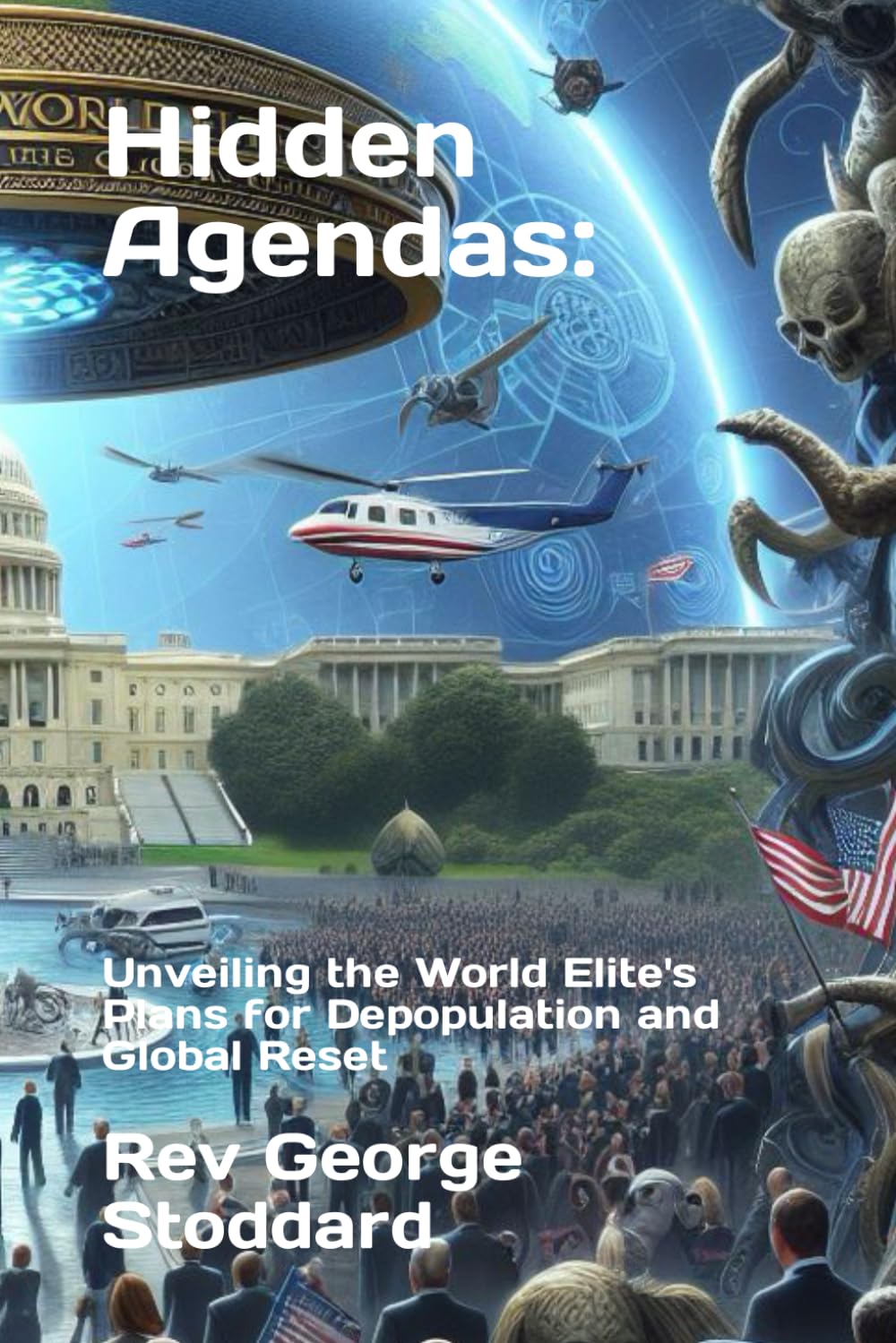

What the elite won't tell you.
Hidden Agendas opens with a question most people are conditioned not to ask: who actually plans the future? Behind the rhetoric of climate, sustainability, and "global reset," Rev. Stoddard documents a world in which a small circle of financiers, technocrats, and institutional actors operate from a coordinated playbook — one most ordinary citizens have never seen, and the press rarely interrogates.
The book's opening chapter, Unveiling the Hidden Agendas, sets the stage. It introduces the players, examines the motives behind depopulation rhetoric, and lays out a timeline of how the "global reset" went from fringe conversation to policy proposal in less than a generation.
"The most dangerous agendas don't hide. They get rebranded as virtue."
Subsequent chapters dig into Methods of Depopulation — the tactics Stoddard argues have been deployed at scale: biological warfare, chemical manipulation, psychological warfare, and the rapid weaponization of new technology. The book examines surveillance and control infrastructure as instruments of compliance, not security, and traces the financial and institutional fingerprints behind it.
From there the investigation widens. The Role of Governments and Institutions exposes the symbiosis between elected bodies, regulatory agencies, and global organizations — covering infiltration of NGOs, media manipulation, and the exploitation of financial systems to keep populations dependent and distracted.
"Every empire in history needed two things: a story, and people too tired to question it."
But the book is not despair. The closing chapters turn to resistance and awakening — the whistleblowers, the activists, the journalists, and the growing global movement of ordinary people who have started to recognize the pattern and refuse to participate in it. Stoddard argues that the agenda only works on a population that doesn't know it exists. Naming it is the first act of resistance.
The implications of the global reset are unpacked in the final sections: economic redistribution dressed as fairness, social engineering dressed as inclusion, technological integration dressed as convenience. The book closes with a call — biblical, sober, and unflinching — to watchfulness, discernment, and faithful action in an age engineered to produce neither.
This is Hidden Agendas. The book they hoped you'd never read.